
Posted in 2010
Reminder
Hi all,
Just reminding you all that we have an Agora today at 12 30 as usual. Last time Jeff had shown us a simulation of band gap in one dimensional periodic dielectric layers. Today we try to understand how we can achieve a photonic band gap in three dimensional structures and the problems which arise hence (Section 3, same paper as before). Looking forward to an exciting discussion as last time!
Cheers,
Gopika
Agora session postponed
Hi all,
Due to the absence of many of us owing to the conference in Lunteren, we postpone the second session of October Agora to this friday (15 October 2010). Hope this will be convenient for most of you.
cheers,
Gopika
Continuing the search for Photonic Band Gap
Dear Agora enthusiasts,
As decided during the last session, we will continue reading the paper ‘Photonic Band Gap Structures’ by E Yablonovitch for tomorrow’s Agora. Let us aim to finish till figure 11, pg 287 this time.
Gopika
Photonic Band Gap Structures
Next Agora we start the discussion on a new topic, ‘Photonic Band gap Structures’. I have chosen one of the early papers on this topic to start the discussion and it is available in the scratch folder [ or please follow this link (http://www.opticsinfobase.org/abstract.cfm?URI=josab-10-2-283) ]. The abstract of the paper is given below.
"The analogy between electromagnetic wave propagation in multidimensionally periodic structures and electron-wave propagation in real crystals has proven to be a fruitful one. Initial efforts were motivated by the prospect of a photonic band gap, a frequency band in three-dimensional dielectric structures in which electromagnetic waves are forbidden irrespective of the propagation direction in space. Today many new ideas and applications are being pursued in two and three dimensions and in metallic, dielectric, and acoustic structures. We review the early motivations for this research, which were derived from the need for a photonic band gap in quantum optics. This need led to a series of experimental and theoretical searches for the elusive photonic band-gap structures, those three-dimensionally periodic dielectric structures that are to photon waves as semiconductor crystals are to electron waves. We describe how the photonic semiconductor can be doped, producing tiny elec-tromagnetic cavities. Finally, we summarize some of the anticipated implications of photonic band structure for quantum electronics and for other areas of physics and electrical engineering."
I suggest that we read till section 3, figure 8 on the first day.
Gopika.
N.B. Since it deals with the first session for October, food will be ordered. Please, take a moment to indicate at this link your presence.
Thanks.
Axel hands over to Gopika
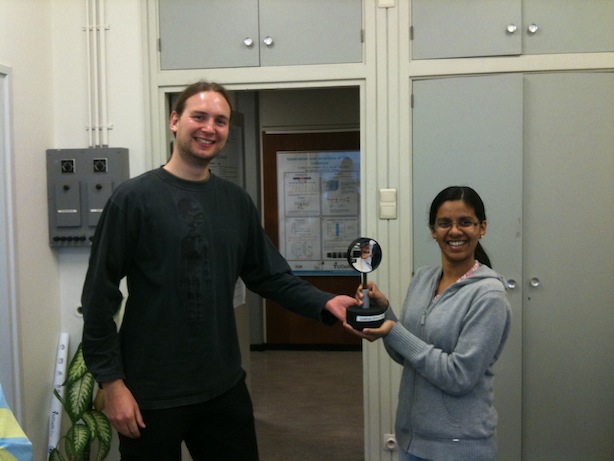
At the last session of Agora, Axel handed over to Gopika the Agora trophy, symbol of the commitment of the chair to the Agora for the coming month!
Gopika will be the chairman of the Agora for the month of October! She will give soon the subject of the month.
Additional Information about camera calibration
If you are interested in camera calibration techniques using projective transformation, please have a look at the additional information in the "ScratchOptica AgoraCamera Calibration" directory.
Calibration of a pinhole camera
On 29th September we will discuss a technique for the calibration of a pinhole camera.
To be prepared, please read the Paper "100929 – On Plane-Based Camera Calibration – A General Algorithm, Singularities, Applications" until the end of section 3 (that’s only 1.5 pages !). The paper can be found in the ScratchOptica Agora directory. In the beginning, I will give a short description of the camera model used in this paper.
List of Chairmans for the coming months
We have decided on the future chairmans for the coming months at the Agora:
| October 2010 | Gopika |
| November 2010 | Adonis |
| December 2010 | Alessandro |
| January 2011 | Nitish |
| February 2011 | Alberto |
The Agora is open to everyone, and we recommend it to the Erasmus Mundus Students, the Master Students and the PhD students. Staff should also be present!
Calbration of the piezo motion of the VINCI instrument, installed at ESO’s VLT Interferometer
Jeff will present us this wednesday some of his work about piezo calibration.
Abstract:
VINCI was the first interferometric instrument used at the VLTI
astronomical interferometer. It performs single spatial mode interference
using an optical fiber combiner using stellar radiation in the astronomical
"K" band (2-2.4 microns). The fringe packet is scanned over its coherence
length using an external path controlled by a piezoelectric actuator.
Alternate scans are in opposite directions, each over a range of about 100
wavelengths. Although the stellar radiation has a much shorter coherence
length, many technical runs used a laser test source which is therefore
coherent over the entire range of each scan and at a specific wavelength,
and from this the motion of the piezo can be derived in detail.
I will present various results concerning the piezo motion derived in this
manner. In addition to an overall error in its velocity compared to its
nominal value, the results display a linear change in the velocity over the
range of the scan (thus a parabolic error in phase), and also a "kink" in
its motion. These effects are distinct between scans in the up and down
directions. In addition to these results concerning the VINCI piezo
actuator, I will present similar conclusions in regard to the piezo
actuator used in the interferometric experiment currently setup to
demonstrate the NOVA Fringe Tracker (NFT) concept using a He-Ne laser.
Further discussion of the characteristics of piezo actuators, widely used
in such interferometric applications, is invited.
Self-calibration of divided circles on the basis of a prime factor algorithm
On 15th
September we will continue our current topic with an example of self
calibration of divided circles. We will discuss the paper "100915 –
Self-calibration of divided circles on the basis of a prime factor
algorithm.pdf". To be prepared, please read the mentioned paper until the end of section 2. The paper can
be found in the ScratchOptica Agora directory.