Posted in October 2010
Comment from Jeffrey Meisner
Hi,
This actually refers to the previous paper on use of a photonic bandgap material especially to prevent spontaneous emission (at frequencies within that bandgap). I think I agree with the physical principles in the paper, but found some (or all) of the discussion regarding applications rather far-fetched and basically impractical — I said that at the 2nd meeting (sorry, I was sick last week so I might have missed further discussion). I think I even agree that you could use the metal film resistor to deliver a current with subpoissonian shot noise to an LED which (if it is nearly 100% efficient) would create a stream of photons with subpoissonian noise (aka squeezed state).
I pointed out previously how impractical it would be to use this squeezed state to lower the noise in an optical communications system (it would require transmission with almost no attenuation and detection with near 100% quantum efficiency). I will put practicallity aside.
Now thinking about it further I also believe that you could create a laser diode taking advantage of the same concept (figure 5). However I think there is a flaw in the concept. Even if you could add energy to the internal wave photon by photon, one for each electron (as I’m willing to concede) it would NOT deliver an output laser beam with a similarly reduced noise. That is because the internal wave of the laser is sampled by the semi-transparent output mirror which randomly allows some (rather small) proportion of the power (photons) to escape. That process itself reintroduces the poisson noise level (just as would attenuation in the communications channel, my previous objection). I also believe that temporally coherent laser radiation with subpoissonian noise would violate the uncertainty principle (but having said that, I need to figure out why it might not apply to the internal wave….).
However with the squeezed-state LED (mentioned on the last page), this objection doesn’t apply, since all photons are directed into the output. But I still insist on the total impracticality of the following communications channel!!
– Jeff
Slow light with Photonic Crystals
Dear All,
For tomorrow’s Agora session, we will discuss one of the applications of Photonic crystals -controlling ‘Slow light’. I have chosen a paper titled ‘Slow light in Photonic Crystal Waveguides’ by Krauss . The paper gives an interesting overview of the principles behind slowing light down in Photonic crystals and its significance. Please find the link below
http://iopscience.iop.org/0022-3727/40/9/S07/pdf/0022-3727_40_9_S07.pdf
Meet you all in the library tomorrow, at the usual time (12:30!)
Cheers,
Gopika
Reminder
Hi all,
Just reminding you all that we have an Agora today at 12 30 as usual. Last time Jeff had shown us a simulation of band gap in one dimensional periodic dielectric layers. Today we try to understand how we can achieve a photonic band gap in three dimensional structures and the problems which arise hence (Section 3, same paper as before). Looking forward to an exciting discussion as last time!
Cheers,
Gopika
Agora session postponed
Hi all,
Due to the absence of many of us owing to the conference in Lunteren, we postpone the second session of October Agora to this friday (15 October 2010). Hope this will be convenient for most of you.
cheers,
Gopika
Continuing the search for Photonic Band Gap
Dear Agora enthusiasts,
As decided during the last session, we will continue reading the paper ‘Photonic Band Gap Structures’ by E Yablonovitch for tomorrow’s Agora. Let us aim to finish till figure 11, pg 287 this time.
Gopika
Photonic Band Gap Structures
Next Agora we start the discussion on a new topic, ‘Photonic Band gap Structures’. I have chosen one of the early papers on this topic to start the discussion and it is available in the scratch folder [ or please follow this link (http://www.opticsinfobase.org/abstract.cfm?URI=josab-10-2-283) ]. The abstract of the paper is given below.
"The analogy between electromagnetic wave propagation in multidimensionally periodic structures and electron-wave propagation in real crystals has proven to be a fruitful one. Initial efforts were motivated by the prospect of a photonic band gap, a frequency band in three-dimensional dielectric structures in which electromagnetic waves are forbidden irrespective of the propagation direction in space. Today many new ideas and applications are being pursued in two and three dimensions and in metallic, dielectric, and acoustic structures. We review the early motivations for this research, which were derived from the need for a photonic band gap in quantum optics. This need led to a series of experimental and theoretical searches for the elusive photonic band-gap structures, those three-dimensionally periodic dielectric structures that are to photon waves as semiconductor crystals are to electron waves. We describe how the photonic semiconductor can be doped, producing tiny elec-tromagnetic cavities. Finally, we summarize some of the anticipated implications of photonic band structure for quantum electronics and for other areas of physics and electrical engineering."
I suggest that we read till section 3, figure 8 on the first day.
Gopika.
N.B. Since it deals with the first session for October, food will be ordered. Please, take a moment to indicate at this link your presence.
Thanks.
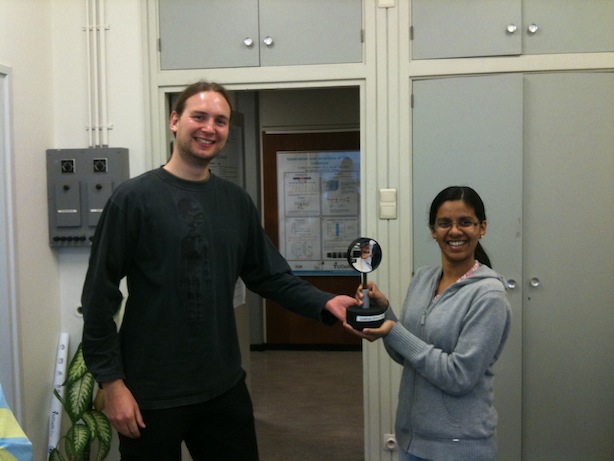
Axel hands over to Gopika
At the last session of Agora, Axel handed over to Gopika the Agora trophy, symbol of the commitment of the chair to the Agora for the coming month!
Gopika will be the chairman of the Agora for the month of October! She will give soon the subject of the month.