
Posted in 2010
Next Agora Session ( Wednesday @ 12.30 h)
Dear all,
in the next Agora session I would like to discuss about interferometric measurement of the temperature dependence of an index of refraction.
I found a recent paper about it by Dupouy at al. from the Univerisite’ de Toulouse, in which they explain their methods in order to do that:
http://www.opticsinfobase.org/abstract.cfm?uri=ao-49-4-678
please have a look at the first 4 paragraphs so we can discuss about it during the meeting.
ciao,
Ale
Schlieren Interferometry
In the next agora session (it will be on Thursday 2nd of December, food will be provided) we start a new subject entitled Schlieren interferometry.
This type of interferometry is interesting to measure temperature and velocity of fluids.
Therefore, I suggest you to start reading the following paper:
Schlieren interferometry. An Optical Methods for determining temperature and velocity distribution in liquids
J.Bruce Brackenridge and W.Paul Gilbert, vol. 4, No. 7, 819, 1965 Applied Optics.
Ale
Next Agora Session on TUESDAY
Dear Agora enthusiasts,
The session of next week is going to be on TUESDAY (23/11/2010) because some of us are not going to be in Delft on Wednesday.
For this session we will continue reading the paper by Steven Chu. We will star on the second column of the second page, and mainly focus on the techniques they used to do their measurements.
For those who would like to have a better picture of the setup they use for this paper, please have a look at this other one
http://prl.aps.org/pdf/PRL/v55/i1/p48_1
Adonis
Magneto Optical Traps (MOT)
Dear friends,
In our next Agora session we will travel inside the exciting world of cold atoms. For that I propose to read the paper by Steven Chu, ‘Trapping o Neutral Sodium Atoms with Radiation Pressure’. It can be found in scratch inside the Optica Agora folder with the name 17112010_MOT.pdf. It can also be downloaded from
http://prl.aps.org/pdf/PRL/v59/i23/p2631_1
See you on Wednesday at 12:30!!
Cheers
Adonis
Agora Session Postponed
Dear all,
Due to the visit and talk of Dr. Philippe Lalanne today, we will postpone the Agora session of this week. We will have it on Friday (November 12th) at 12:30, as usual in the Optical Library. Please read the previous post: Optical Tweezers, to know which sections of the paper we are going to discuss.
Regards
Adonis
Optical Tweezers
Dear friends,
This Wednesday (November 10) we will continue our trip on optical trapping. This time we will focus on the principle and applications of Optical Tweezers. For that we will read sections VII and VIII of the paper by Ashkin (same of last week), seams long but there is not much theory in it, it is mainly about applications.
On the other hand, the theory is based on geometrical optics, so we can have a nice discussion if we think about the effect of reflection, index of refractions, etc.
See you on Wednesday at 12:30
Cheers
Adonis
Adonis is the new Chairman
Gopika has transfered the Agora Trophy to Adonis for the month of November!
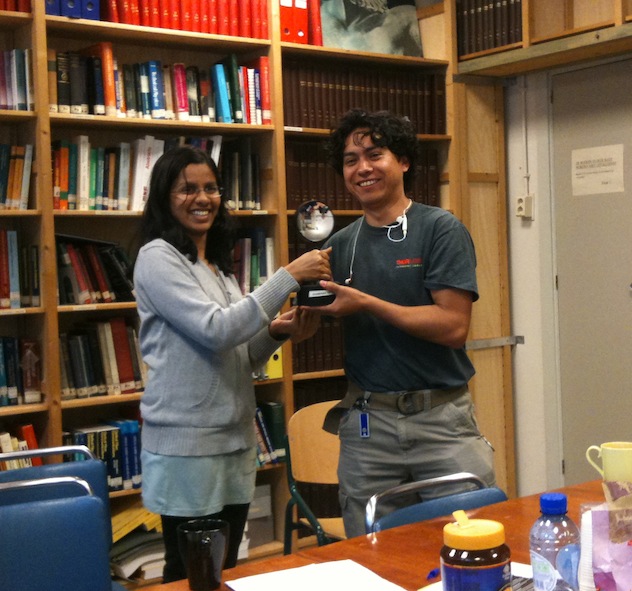
November Agora
Dear all,
Comment from Jeffrey Meisner
Hi,
This actually refers to the previous paper on use of a photonic bandgap material especially to prevent spontaneous emission (at frequencies within that bandgap). I think I agree with the physical principles in the paper, but found some (or all) of the discussion regarding applications rather far-fetched and basically impractical — I said that at the 2nd meeting (sorry, I was sick last week so I might have missed further discussion). I think I even agree that you could use the metal film resistor to deliver a current with subpoissonian shot noise to an LED which (if it is nearly 100% efficient) would create a stream of photons with subpoissonian noise (aka squeezed state).
I pointed out previously how impractical it would be to use this squeezed state to lower the noise in an optical communications system (it would require transmission with almost no attenuation and detection with near 100% quantum efficiency). I will put practicallity aside.
Now thinking about it further I also believe that you could create a laser diode taking advantage of the same concept (figure 5). However I think there is a flaw in the concept. Even if you could add energy to the internal wave photon by photon, one for each electron (as I’m willing to concede) it would NOT deliver an output laser beam with a similarly reduced noise. That is because the internal wave of the laser is sampled by the semi-transparent output mirror which randomly allows some (rather small) proportion of the power (photons) to escape. That process itself reintroduces the poisson noise level (just as would attenuation in the communications channel, my previous objection). I also believe that temporally coherent laser radiation with subpoissonian noise would violate the uncertainty principle (but having said that, I need to figure out why it might not apply to the internal wave….).
However with the squeezed-state LED (mentioned on the last page), this objection doesn’t apply, since all photons are directed into the output. But I still insist on the total impracticality of the following communications channel!!
– Jeff
Slow light with Photonic Crystals
Dear All,
For tomorrow’s Agora session, we will discuss one of the applications of Photonic crystals -controlling ‘Slow light’. I have chosen a paper titled ‘Slow light in Photonic Crystal Waveguides’ by Krauss . The paper gives an interesting overview of the principles behind slowing light down in Photonic crystals and its significance. Please find the link below
http://iopscience.iop.org/0022-3727/40/9/S07/pdf/0022-3727_40_9_S07.pdf
Meet you all in the library tomorrow, at the usual time (12:30!)
Cheers,
Gopika