
Posted in 2011
Agora Tomorrow
Dear all
the agora session, chaired by Kate will occur tomorrow wednesday at 12.30. We are not sure that the food will be delivered. We will not that at 12.00.
See you ALL tomorrow!
Chairman Found
Dear all,
Kate has agreed to take care of the chair for the Agora. The paper she has chosen is:
Generation of radially and azimuthally polarized light by optical transmission through concentric circular nanoslits in Ag films
by Feng Wang, Min Xiao, Kai Sun, and Qi-Huo We, Opt. Express 18, 63-71 (2010)
You can find it in the Scratch under the filename:
110607 – Generation of radially and azimuthally polarized.pdf
or on the web.
The date of the Agora (Tuesday or Wednesday) will be given shortly!
New agora
Dear all,
we are looking for a brave chairman for the June AGORA. Please contact me, as soon as possible. June will be the last session before the Summer Break!
Todays agora
Today we continue with our discussion about the review paper "Light in Tiny Holes".
We restart from page 41 "single apertures surrounded by periodic corrugations"
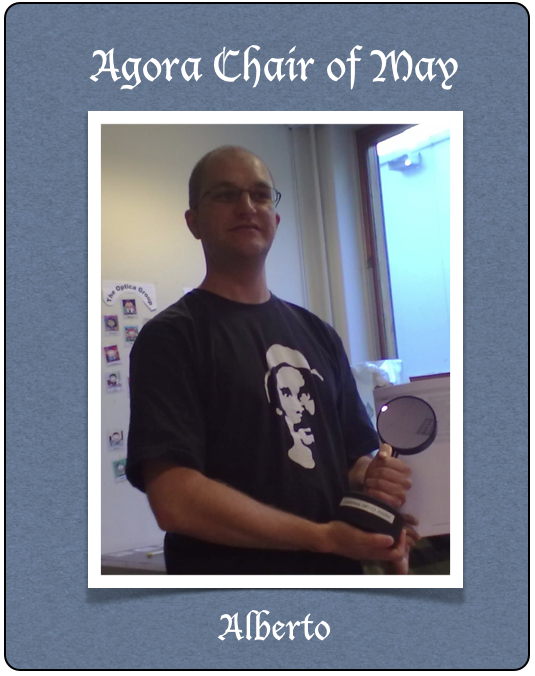
Picture of the Agora Chairman of the month of May
We have forgotten to put the picture of the Agora Chairman of the month of May. Here it is Alberto!
Next Tuesday
In the last Agora we started to discuss about the review paper "Light in tiny holes". We saw that the first attempt to describe such problem was made by Bethe in early 40’s. However, the theory fails when compared to recent experimental results. The problem was that the Bethe’s theory considered an infinitly thin metal layer, which is a strong idealization. When we considered the effects of a hole in a metal layer with thickness ‘d’, we realized that ‘surface plasmons’ started to play an important role in the problem’s analysis. Therefore, we decided to get a better understanding in this subject. So, for the next week, bring your contribution to the "surface plasmon" discussion. After that, we continue on the paper, restarting from the box 2.
be Aware we are meeting on TUESDAY 10th of May!!!!!
Light in tiny holes
Dear all
Alberto has found a nice paper for us at the agora. It is called "Light in tiny holes". In fact, this is a review of this subject published in nature.
The idea is to discuss what happens when light is incident in structures way smaller than the wavelength employed.
Since some of us have already experience in this field, it will be easier to discuss and share knowledge.
You can find the paper on the scratch under the name "110504 – Light in Tiny Holes" or go directly to the Link to the paper
"Light in tiny holes" by Genet, C. and Ebbesen, T. W.
Nature, Volume 445, Issue 7123, pp. 39-46 (2007).
Be all there at 12.15 tomorrow!
Next Agora, this wednesday
Dear all,
the next agora will be given at 12.15 on wednesday the 4th of May 2011. Alberto will be the speaker. He will give us the paper to ready tomorrow!
Aurele
Last session
Last session bringed us to the final part of the paper: we are reaching the experimental part, which is less mathematical and formula than the other parts. So we believe that anyone can (and Should) attend this session.
So please read the last Part IV for next agora!
For the Agora, Aurele
What have we been discussing?
As you can see, Aurele has extended for the next 2 weeks the discussion regarding optical antennas INCLUDING some related or less related issues which pop up! So perhaps we can get further on Wednesday, perhaps even to section 4 (applications) but also to see if there is further interest in addressing the qualitative discussion in 3.8, and 3.9 (nonlinearity in metals!). We’ll just have to skip past the final sentence of section 3.7 which I still cannot believe and is such an amaxing finding that it should have required its own paper 😉
However last time we did get into a serious discussion of the complex refractive index of metals which goes beyond the question of antennas but is obviously of great importance to anyone who uses metals at optical frequencies (such as Aluminumized mirrors) and wants to understand how they work — quantitatively. In particular there was the issue of epsilon_infinity (assymptotic value at high frequencies well past the plasma frequency): should it be unity, or something else? And if it IS something >1, then does that not affect the plasma frequency?
I had referred to a table in Feynman table 32-3 (in my old edition) taken from Kittel which tabulates the predicted and experimental plasma frequencies of alkalii metals (from an old experiment by Robert Wood, I believe, who realized that metals would become transparent in the far UV). Now I have done a calculation based on the conductivity, valence, and density of Lithium (all well known) but assuming epsilon_infinity = 1 (as Feynman does) and have plotted the result here:
http://www.strw.leidenuniv.nl/~meisner/LithiumIndexTheory.jpg
This is very consistent with Feynman/Kittel but differs significantly from this reference (which shouldn’t be taken as ABSOLUTELY true, but is the best I can find):
http://refractiveindex.info/?group=METALS&material=Lithium
Note that he plots Re{n} at the top and Im{n} down below vs. microns, as I do. Comments?